Blogs

Professional Digital Marketing Strategist in Calicut helping businesses grow with SEO, Google Ads, WordPress, and digital marketing strategies.
Blogs

How to Choose the Right Digital Marketing Strategist in Calicut

✦ Digital Marketing How to Choose the Right Digital Marketing Strategist in Calicut Discover how to choose the right Digital Marketing Strategist in Calicut to boost visibility, attract customers, and grow your business. 27 July 2026 Aswani Soman How to Choose the Right Digital Marketing Strategist in Calicut In today’s digital-first world, having an online presence is no longer enough. Your business needs a strategy that attracts the right audience, generates quality leads, and converts visitors into loyal customers. Whether you’re a startup, a local business, or an established brand in Calicut, partnering with the right digital marketing strategist can make all the difference. However, with so many freelancers, agencies, and consultants offering similar services, choosing the right professional can feel overwhelming. How do you know who truly understands your business? Which qualities should you look for? And what questions should you ask before making a decision? This guide will help you choose the right digital marketing strategist in Calicut and ensure your investment delivers measurable results. The Reasons Your Company Needs a Digital Marketing Strategist Many entrepreneurs believe that posting frequently on Instagram or running a few social media advertising is sufficient. Although these efforts are crucial, effective digital marketing requires much more. Based on your company’s objectives, a digital marketing strategist develops a personalised plan. They integrate SEO, paid advertising, content marketing, website optimisation, email marketing, and social media into a single, coherent approach rather than concentrating on discrete marketing initiatives. Stronger internet visibility, better client interaction, and long-term company growth are the outcomes. Understand Your Business Goals First Before searching for a digital marketing strategist, define what you want to achieve. Ask yourself: Do you want more website traffic? Are you looking for more local customers? Do you need better Google rankings? Do you want to generate qualified leads? Is your goal to increase online sales? Do you want to build your brand awareness? Having clear objectives makes it easier to find a strategist with the right expertise. For example, a restaurant in Calicut may focus on local SEO and Google Business Profile optimisation, while an e-commerce store may require paid advertising and conversion optimisation. Let’s Connect Name Email Message Send Table of Contents

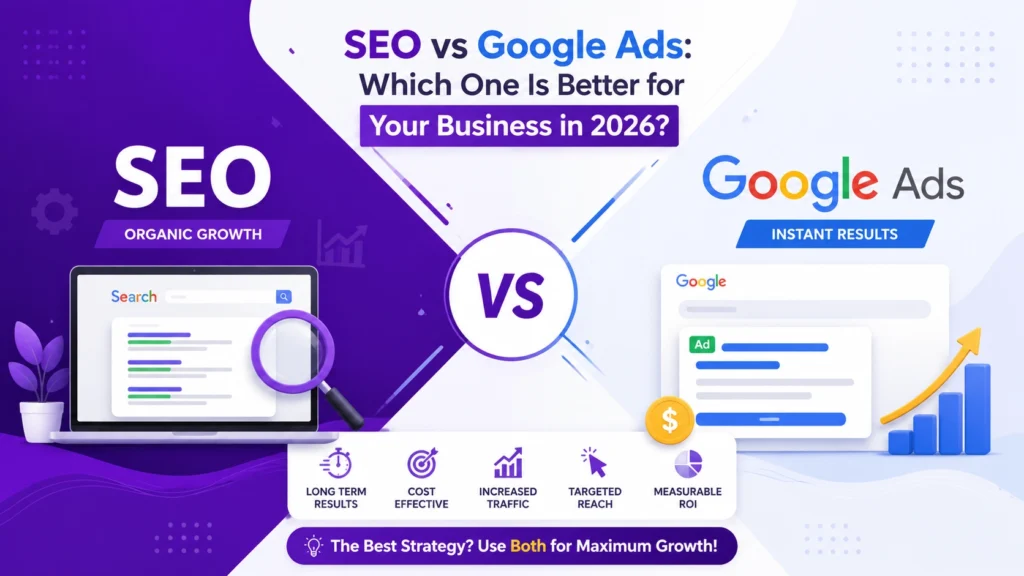
SEO vs Google Ads comparison for businesses in 2026
Blogs

SEO vs Google Ads: Which One Is Better for Your Business in 2026?

Growing a business online has never been more important. Whether you’re a startup, a local business, or an established company, your customers are searching for products and services on Google every day. This is why many business owners ask the same question: Should I invest in SEO or Google Ads? Both strategies can help you attract visitors, generate leads, and increase sales, but they work in completely different ways. SEO focuses on improving your website’s visibility in Google’s organic search results, while Google Ads allows you to appear at the top of search results through paid advertising. So, which one is the better choice in 2026? The answer depends on your business goals, budget, and how quickly you want to achieve results. In this guide, you’ll learn how both strategies work, their advantages, their limitations, and when you should use each one. What Is SEO? Search Engine Optimization (SEO) is the process of improving your website so that it ranks higher in Google’s organic search results. Instead of paying for every visitor, SEO helps your website attract traffic naturally by providing useful content, improving website performance, and optimizing pages for search engines. SEO involves several important activities, including: Example Imagine you own a bakery in Calicut. When someone searches for “best bakery in Calicut,” a well-optimized website has a much better chance of appearing on the first page of Google. Every visitor who clicks your website through these organic results comes without paying Google for that click. This makes SEO one of the most sustainable digital marketing strategies available. What Are Google Ads? Google Ads is Google’s online advertising platform that enables businesses to display paid advertisements at the top of search results. Unlike SEO, you don’t have to wait for your website to rank. Your advertisement can appear almost immediately after your campaign is launched. With Google Ads, you only pay when someone clicks on your advertisement. This advertising model is known as Pay-Per-Click (PPC). Businesses commonly use Google Ads for: Example Suppose you’re opening a new home cleaning service. If someone searches for “home cleaning service near me,” your advertisement can appear at the top of Google within hours, helping you generate enquiries almost immediately. The Biggest Difference Between SEO and Google Ads Although both strategies help businesses attract customers through Google Search, they serve different purposes. SEO is a long-term investment. It takes time to build authority and improve rankings, but once your pages rank well, they can continue bringing visitors without paying for every click. Google Ads is designed for speed. It can generate traffic as soon as your campaign goes live, but once your advertising budget is exhausted, the traffic stops. In simple terms: Understanding this difference is essential when deciding which strategy suits your business. Benefits of SEO One of the biggest advantages of SEO is its ability to generate consistent, long-term traffic. A well-optimized website can continue attracting visitors for months or even years with regular updates. SEO also helps build trust. Many users naturally trust websites that appear in Google’s organic search results because they are earned rather than purchased. Another major benefit is improved user experience. SEO encourages faster websites, mobile-friendly designs, better navigation, and valuable content—all of which improve customer satisfaction. For local businesses, Local SEO makes it easier to appear in Google Maps and location-based searches, helping nearby customers discover your business. Challenges of SEO SEO delivers excellent long-term value, but it requires patience. Results don’t happen overnight. Depending on your industry and competition, it may take several months before your website reaches the first page of Google. SEO also requires continuous effort. Search engines regularly update their algorithms, and competitors are constantly improving their websites. To maintain rankings, businesses need to publish quality content, update existing pages, and optimize their websites regularly. Challenges of Google Ads Google Ads can produce fast results, but it comes with ongoing costs. Highly competitive industries often have expensive keywords, making campaigns costly if they aren’t managed carefully. Another limitation is that traffic stops when advertising stops. If your budget runs out, your visibility disappears immediately. Successful campaigns require regular monitoring, keyword optimization, and conversion tracking to maximize return on investment. Which Strategy Should You Choose? The right choice depends on your business objectives. If you’re looking for immediate enquiries, launching a new product, or promoting a limited-time offer, Google Ads is usually the faster option. If you’re building a long-term online presence and want sustainable traffic without paying for every visitor, SEO is the better investment. Many successful businesses don’t choose one over the other. Instead, they combine both strategies. Google Ads helps generate immediate leads, while SEO builds lasting authority and organic traffic that continues growing over time. Why Combining SEO and Google Ads Is the Smartest Strategy Instead of viewing SEO and Google Ads as competitors, think of them as complementary marketing tools. Businesses that invest in both strategies often achieve stronger and more consistent growth. Final Thoughts There isn’t a single answer to the question, “Which is better—SEO or Google Ads?” Both strategies have unique strengths. SEO is ideal for businesses focused on long-term growth, brand credibility, and sustainable traffic. Google Ads is perfect for businesses that need quick visibility, immediate leads, and measurable results. For many businesses, the most effective solution is a balanced digital marketing strategy that combines both. Frequently Asked Questions 1. Is SEO better than Google Ads? SEO is better for long-term growth and organic traffic, while Google Ads is ideal for businesses that need immediate visibility and faster lead generation. How long does SEO take to show results? Most businesses begin seeing noticeable improvements within three to six months, although this varies depending on competition and website quality. Can I use SEO and Google Ads together? Absolutely. Combining SEO and Google Ads often produces the best results by balancing immediate traffic with sustainable long-term growth. Which option is more cost-effective? SEO generally offers better long-term value because there is no cost for each

Top 10 digital marketing trends every business should know in 2026
Blogs

10 Digital Marketing Trends Every Business Should Know in 2026

Digital marketing continues to evolve at a remarkable pace, and 2026 is proving to be another transformative year. With artificial intelligence becoming more accessible, search engines prioritizing user experience, and customer expectations constantly changing, businesses must adapt to remain competitive. Whether you’re a startup, a local business, or an established brand, understanding the latest digital marketing trends can help you reach the right audience, generate quality leads, and achieve sustainable growth. In this blog, we’ll explore the 10 most important digital marketing trends every business should know in 2026. Artificial Intelligence Is Becoming an Everyday Marketing Artificial Intelligence (AI) is no longer a futuristic concept—it’s now an essential part of digital marketing. Businesses are using AI to create content, automate repetitive tasks, analyze customer behavior, and personalize marketing campaigns. AI-powered tools help marketers save time while improving efficiency. From generating social media captions to analyzing campaign performance, AI enables businesses to make smarter decisions based on real-time data. However, successful marketing still requires human creativity. AI should support your strategy, not replace it. Search Intent Matters More Than Keywords SEO is no longer just about inserting keywords into your content. Search engines have become much better at understanding what users actually want when they type a query. Instead of focusing solely on keyword density, businesses should create content that answers questions, solves problems, and provides real value. For example, someone searching for “best digital marketing strategy for small businesses” is looking for practical guidance—not just a list of keywords. Creating helpful, informative content increases your chances of ranking higher and building trust with your audience. Short-Form Video Continues to Dominate Short videos remain one of the most engaging content formats across platforms like Instagram Reels, YouTube Shorts, and TikTok. Consumers prefer quick, informative videos that are easy to watch and share. Businesses can use short-form videos to: You don’t need expensive equipment. A smartphone, good lighting, and valuable content are often enough to create videos that resonate with your audience. Local SEO Is More Important Than Ever If your business serves customers in a specific city or region, Local SEO should be a top priority. Many consumers search for services using phrases like: Optimizing your Google Business Profile, collecting genuine customer reviews, maintaining accurate business information, and creating location-specific content can significantly improve local visibility. Local SEO helps businesses appear in Google Maps and local search results, making it easier for nearby customers to find them. Personalized Marketing Builds Stronger Relationships Today’s customers expect personalized experiences. Generic marketing messages are becoming less effective because consumers want brands to understand their preferences and needs. Personalization can include: When businesses deliver relevant experiences, customers are more likely to engage and make purchasing decisions. Content Quality Will Always Win As AI-generated content becomes more common, originality and expertise have become even more valuable. Search engines increasingly reward content that demonstrates real knowledge, practical experience, and genuine value. Instead of publishing large amounts of generic content, focus on creating well-researched articles that answer your audience’s questions. Adding examples, case studies, expert insights, and actionable tips makes your content more trustworthy and engaging. Email Marketing Remains One of the Highest ROI Channels Despite the growth of social media, email marketing continues to deliver excellent returns. A well-planned email strategy allows businesses to: Modern email marketing focuses on personalization rather than mass messaging. Segmented email lists and relevant content help improve open rates and conversions. Website Experience Directly Impacts Marketing Success Your website is often the first impression potential customers have of your business. Even the best marketing campaign can fail if your website is slow, difficult to navigate, or not mobile-friendly. An effective website should: A well-designed website not only improves SEO but also increases trust and encourages visitors to take action. Data-Driven Marketing Leads to Better Decisions Successful businesses don’t rely on guesswork. They use data to understand what works and what doesn’t. Analytics tools help track important metrics such as: By regularly reviewing this information, businesses can refine their marketing strategies, allocate budgets more effectively, and improve overall performance. Building Trust Is the Ultimate Competitive Advantage Consumers have countless choices online, making trust one of the most valuable assets a business can earn. Building trust takes time, but it can be achieved by: People are more likely to buy from businesses they trust, recommend them to others, and become repeat customers. In 2026, trust isn’t just a branding element—it’s a powerful marketing strategy. Final Thoughts Digital marketing continues to evolve, but its core objective remains the same: connecting businesses with the right audience at the right time. The trends shaping 2026—AI-powered tools, personalized experiences, search intent, local SEO, high-quality content, and data-driven strategies—are all centered around providing better experiences for customers. Rather than chasing every new trend, focus on the ones that align with your business goals and audience. Start by strengthening your website, creating valuable content, optimizing for search, and building genuine relationships with your customers. Businesses that embrace change while staying focused on delivering value will be well-positioned for success in the years ahead. Digital marketing isn’t just about increasing traffic or generating leads—it’s about creating meaningful connections that help businesses grow sustainably.  

Scroll to Top